" LangLing "
English Language, Jokes, Facts, Etymology, Translation, etc" LangLing "
English Language, Jokes, Facts, Etymology, Translation, etcجملات و اصطلاحات انگلیسی
شکایت بیمار
۱- دکتر، امروز حالم خوب نیست.
Doctor, I am not feeling well today.
2- مشکل تون چی است؟
What’s the matter with you? / What’s wrong with you?
3- حالت تهوع دارم.
I feel sick. / I feel queasy.
4- معمولاً بعد از ناهار یا شام حالت تهوع پیدا می کنم.
I usually feel like throwing up after lunch or dinner.
5- شب زیاد سرفه می کنم.
I cough a lot at night.
6- آیا شب ها خر پف می کنید؟
Do you snore at night?
7- اول دماغم آب می آمد، ولی حالا گرفته است.
At first my nose was runny, but now it is stuffed up.
8- می بینم که صداتون هم گرفته است.
I see you are hoarse, too.
9- رنگ تون پریده. لطفاً پیراهنتان را بزنید بالا.
You look pale. Pull up your shirt, please.
10- دهانتان را خوب باز کنید. می خواهم نگاهی به گلویتان بیاندازم.
Open your mouth wide; I want to look at your throat.
11- بگذارید نبض تون/ فشار خونتون را بگیرم.
Let me take your pulse/ blood pressure.
12- این دماسنج را زیر زیانتان بگذارید.
Rest this thermometer under your tongue.
13- کمرم بد جوری درد می کند.
I have a terrible backache.
14- سرما خورده ام و بدنم سست است.
I have a cold and feel sluggish.
15- سینه ام درد می کند.
I have a pain in my chest.
16- چشم چپم درد شدیدی / خفیفی دارد.
I have a sharp pain/ dull pain in my left eye.
17- دیروز دو بار غش کردم.
I passed out/ fainted twice yesterday.
18- میشه برام آزمایش ادرار و خون بنویسید؟
Will you please order some urine and blood tests for me?
7 Measurements
Here are 7 systems of measurement for things like time,
distance and money.
oooooooooooooooooooooooooooooooooooooooooooooooooooooooooooo
1. TIME
1000 milliseconds = 1 second (sec)
60 seconds = 1 minute (min)
60 minutes = 1 hour (hr)
24 hours = 1 day
7 days = 1 week (wk)
28, 30 or 31 days = 1 month (mth)
12 months = 1 year (yr)
365 days = 1 year
BUT every 4th year = 366 days (a leap year)
Also note:
52 weeks = 1 year (approximately)
People often use the following terms:
48 hours (2 days)
72 hours (3 days)
oooooooooooooooooooooooooooooooooooooooooooooooooooooooooooo
2. DISTANCE
There are two systems for measuring distance in the English-
speaking world:
a) metric
10 millimetres (mm) = 1 centimetre (cm)
100 centimetres = 1 metre (m)
1000 metres = 1 kilometre (km)
b) imperial/US
12 inches (in) = 1 foot (ft)
3 feet = 1 yard (yd) (approximately 1 metre)
1760 yards = 1 mile (approximately 1.6 km)
oooooooooooooooooooooooooooooooooooooooooooooooooooooooooooo
3. AREA
Area is the extent of a surface. It is 2-dimensional. Area
is often expressed using the word "square" + the distance.
For example, if a room is 10 metres long and 5 metres wide,
it is 50 square metres (50 sq. m). But we can also use the
distance + the figure 2. Then we would write 50m2.
Here are two examples:
My table is 3 metres long x 2 metres wide:
area = 6 sq.m, or
area = 6m2
My town is 3 miles x 4 miles:
area = 12 sq. miles
We often measure the area of land using:
hectare = 10,000 square metres
acre = 4,840 square yards
Warning!
There is a difference between "square metres" and "metres
square". If my room is 10 feet x 10 feet, it is 100 square
feet but 10 feet square. We can only say this when the
length and the width are the same.
oooooooooooooooooooooooooooooooooooooooooooooooooooooooooooo
4. VOLUME
Volume is the amount of space occupied by an object or
enclosed in a container. It is 3-dimensional. Volume is
often expressed using the word "cubic" + the distance. For
example, if a room is 5 metres long, 3 metres wide and
3 metres high, it is 45 cubic metres (45 cu. m). But we can
also use the distance + the figure 3. So we write 45m3.
Other measurements of volume are:
- 1000 cubic centimetres (cc) = 1 litre (L or l)
- gallon (approx. 4.6 litres in UK, approx. 3.8 liters in US)
We use litres to talk about fluids like drinks and petrol.
We also use gallons to talk about petrol and other fluids.
oooooooooooooooooooooooooooooooooooooooooooooooooooooooooooo
5. SPEED
Speed is a measurement that combines distance, quantity,
volume etc AND time. Common ways of talking about the speed
of a car, for example, are:
- 50 miles per hour (50mph)
- 50 kilometres per hour (50kph)
We also use the symbol / when talking about speed:
- 50 people/hour (50 people per hour)
- 1000 l/hr (1000 litres per hour)
oooooooooooooooooooooooooooooooooooooooooooooooooooooooooooo
6. WEIGHT
There are two systems to measure how heavy something is:
a) metric
1000 grams (g) = 1 kilogram (kg)
1000 kilograms = 1 metric ton (metric tonne)
b) imperial/US
16 ounces (oz) = 1 pound (lb)
14 pounds = 1 stone (British)
100 pounds = 1 hundredweight (cwt)*
20 hundredweights = 1 ton*
*There is a slight difference between British and US
hundreweights and tons.
oooooooooooooooooooooooooooooooooooooooooooooooooooooooooooo
7. MONEY
Most countries use a basic monetary unit (for example the
dollar) divided into 100 fractional units (example cents).
They use a combination of paper money (banknotes or notes)
and metal money (coins).
Here are some examples from the world's major currencies:
USA: American Dollar (USD or $)
1 dollar = 100 cents
UK: British Pound (GBP or £)
1 pound = 100 pence
European Union: Euro (EUR)
1 euro = 100 cents
Japan: Japanese Yen (JPY)
1 yen = 100 sen (not used today)
Switzerland: Swiss Franc (CHF)
1 franc = 100 centimes
oooooooooooooooooooooooooooooooooooooooooooooooooooooooooooo
Tip!
Words like metre and litre are spelled differently in the
UK and US. The British write metre, kilometre, litre etc.
The Americans write meter, kilometer, liter etc.
oooooooooooooooooooooooooooooooooooooooooooooooooooooooooooo
No, Any, Some
نکـــــاتی درباره ی no-any-some
some به معنی مقداری یا تعدادی صفت مقدار می باشد و می تواند قبل از اسمهای قابل شمارش جـمع و همچنین قبل از اسمهای غیر قابل شمارش بکار رود .
.I have some books
.I have some money
Some
اغلب در جمــلات مثبت بــکار می رود و معادل آن در جملات منفی و سـوالی کلمه ی any به معنی هیچ یا اصــلأ می باشد . توضیح اینکه any همــانند some مـی تواند هم قبـل از اسمهای قابــل شمارش جمع و هم قبل از اسمهای غیر قابل شمارش بکار رود .
.There are some pens on the table
.There are not any pens on the table
?Are there any pens on the table
تذکر1 : در جمـــلات منفی می توانیم ترکیب not any را حذف کرده و بجای آنــــها کلمـه ی no را قـرار دهیم . no نیز همــانند some و any هم قبل از اسمهای قابــــل شمارش جمـع و هم قبــــل از اسمهای غیر قابل شمارش بکار می رود .
تذکر2 : no در جملات مثبت بکار می رود ولی به جمله مفهوم منفی می بخشد .
.There are not any pens on the table
.There are no pens on the table
.I did not drink any milk
.I drank no milk
یادآوری :کلمات مرکبی که با some – any و no ساخته می شوند نیزاز قوانین فوق پیروی می کنند.
somebody – someone - something
anybody – anyone - anything
nobody - no one - nothing
.I see somebody in the library
.She didn't eat anything
.You will say nothing
I Love You in African Languages
|
Brazilian Portuguese |
Eu te amo |
|
Cheyenne |
Ne mohotatse |
|
Chichewa |
Ndimakukonda |
|
Creol |
Mi aime jou |
|
Hawaiian |
Aloha wau ia oi |
|
Hopi |
Nu' umi unangwa'ta |
|
Inuit |
Negligevapse |
|
Mohawk |
Kanbhik |
|
Nahuatl |
Ni mits neki |
|
Navaho |
Ayor anosh'ni |
|
Papiamento |
Mi ta stimabo |
|
Tahitian |
Ua Here Vau Ia Oe |
|
Sioux |
Techihhila |
Charles J. Fillmore
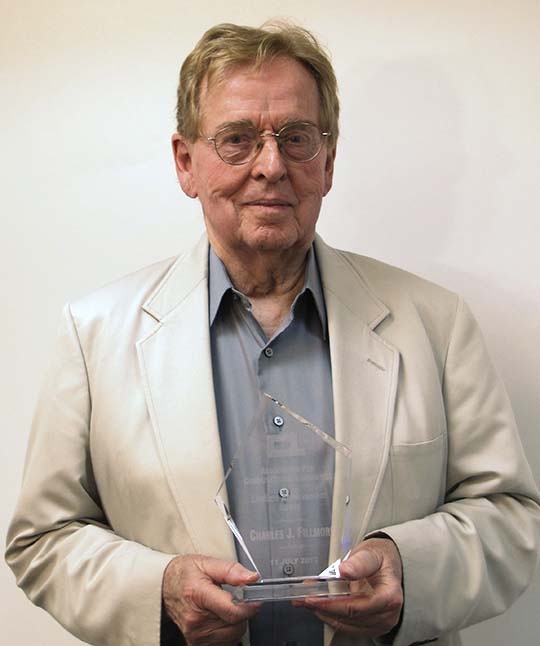
Charles J. Fillmore, Discoverer of Frame Semantics, Dies in SF at 84:
He Figured Out How Framing Works
Charles J. Fillmore, one of the world’s greatest linguists — ever — died last Thursday, February 13, at the age of 84 in San Francisco. He was the discoverer of frame semantics, who did the essential research on the nature of framing in thought and language. He discovered that we think, largely unconsciously, in terms of conceptual frames — mental structures that organize our thought. Further, he found that every word is mentally defined in terms of frame structures. Our current understanding of “framing” in social and political discourse derives ultimately from his research, whose importance stretches well beyond linguistics to social and political thought — and all of intellectual life. The world has lost a scholar of the greatest significance.
“Chuck,” as he was known throughout the linguistics world, got his PhD from the University of Michigan in 1961 and taught at Ohio State University until 1971, when he came to the University of California at Berkeley. Chuck’s wife of 40 years, Lily Wong Fillmore, put herself through college and then through graduate school at Stanford, winding up as Professor of Education at Berkeley. She was his constant companion, sounding board, alter ego, the greatest cheer in his life, and much more.
Chuck taught at Berkeley for 23 years until his retirement in 1994. As a Professor Emeritus, he ran a research project on Frame Semantics called FrameNet at the International Computer Science Institute at UC Berkeley for 18 years until 2012, when he became ill.
If you are interested in how our understanding of framing in public discourse developed, you need to know about Chuck.
Chuck’s insights have had a profound effect on the fields of both linguistics and cognitive science. As one of the earliest exponents of Noam Chomsky’s transformational grammar, Chuck discovered what is known as the “transformational cycle” in 1963, even before Chomsky came up with the idea of “deep structure.” My own relationship with Chuck began in that year, when he came to speak on that topic at the Indiana University Graduate Linguistics Club. Ever gracious, he accepted my invitation as an officer of the club and drove all the way from Columbus, Ohio to speak to our graduate students for nothing more than an Indiana potluck dinner. I have revered him ever since, and our lives and work have been intertwined over more than 50 years.
By 1965, we both became convinced of the massive role of semantics in grammar, but we came up with very different theories. My tack was to introduce formal logic as semantics into linguistics in late 1963. But Chuck, with greater insight, noticed that grammar is organized in terms of the most basic experiences of everyday life, for example, action and perception. He observed that such experiences have a basic structure — wholes with parts: Thus an action can have Agents, their Acts, Patients (what they act on), Purposes, Instruments, Locations, Times, and so on. Perception involves an Experiencer, and experience, a Stimulus of the Experience, and so on. He called these conceptual elements of experience “cases” on an analogy with case languages like Latin and Greek. He called his theory “Case Grammar,” showing that there are rules of grammar that crucially make use of such very general conceptual elements that structure our experience. I heard him speak on the idea at MIT in the summer of 1965, and began following his development of the theory. He published the idea in 1968, and the idea spread. A version of that idea is now taken for granted pretty much throughout the linguistic world, partly though Chuck’s work and partly through a 1965 MIT dissertation by Jeff Gruber, who left linguistics shortly thereafter to become a Baha’i missionary. In the cognitive tradition following Chuck, they are called “semantic roles.” In the generative tradition, they are called “theta-roles.” The insights are similar and were discovered independently at about the same time.
Chuck arrived at Berkeley in 1971, and I followed in 1972. We began working together, as well as taking part in a cognition discussion group that included Dan Slobin, Eleanor Rosch, Wally Chafe, Paul Kay, Steve Palmer, John Gumperz, and occasionally, Paul Grice. That became the core of cognitive science at Berkeley. When the field was formed later in the 1970’s, Berkeley became the West Coast center of the field. In 1974-75, while Chuck was developing frame semantics and I was helping, we were regularly visited in my living room by three friends who drove over from Palo Alto — Terry Winograd, Danny Bobrow, and Don Norman. They wanted to find out what they could about the details of frame semantics since they were working on a knowledge representation language for computer science, which eventually developed into KL-ONE — a classic frame-based knowledge representation language in computer science. It was because of Chuck that it came to be “frame-based.”
In 1975, Chuck published his first paper on frame semantics in the first issue of the Publications of the Berkeley Linguistics Society, and in 1976 published a second version in 1976 in The Annals of the New York Academy of Sciences. Frame semantics was a much-elaborated version of case grammar. Chuck had been studying European linguistic research on “semantic fields” — groups of related words like knife-fork-spoon,Sunday, Monday, Tuesday, … and so on. Chuck realized that they were also based on organized mental structures of common experiences, but he went a major step further: the hypothesis that every word in every language is mentally defined by elements of such mental structures, which he called “frames.” Chuck’s classic example involved the semantic field buy-sell-goods-price-cost. The common mental structure defining such words is based on the commercial event scenario: Person 1 has possessions and wants to exchange them for money. Person 2 has the money and wants to exchange it for such a possession. There is mutual exchange. Person 1 is called a seller; Person 2 is called a buyer; the possession exchanged is called the goods; and the money is called the price. Those named the basic “semantic roles” — the conceptual elements of the frame.
Being Chuck, he went further. Sentences that looked very different have meanings characterized by the same frame. Chuck sold the book to Paul for $10. Paul bought the book from Chuck for $10. The book cost Paul $10. Chuck got $10 for the book. Moreover, each verb defined by that frame has its own grammar associated with it. With sell, the Seller is Subject, the goods is direct object, the buyer is marked by to and the price is marker by for. With cost, the goods is subject, the price is direct object and the Buyer is indirect object.
This is a very simple example. There is a great deal more to frames. In the 18 years Chuck worked on the FrameNet project, over a thousand frames were described in detail. They are publicly accessible on the web at www.framenet.icsi.berkeley.
The study of frame semantics became the study of (1) which frames do we use in conceptualizing our experience, (2) what semantic roles and scenarios define each frame, (3) what words are defined by which frames, (4) what is the grammar associated with the frame elements, and (5) how are frames related to one another.
I was hooked on frame semantics by 1975, and started working with Chuck on a linguistic theory that would incorporate frames. We called it Construction Grammar. The idea was to provide a unified theory of grammar and word meaning.
After working together on it for several years, we wound up creating two different versions of Construction Grammar for very different purposes. Chuck had always thought of himself as an Ordinary Working Linguist (an OWL, as he referred to himself). His goal was to provide a useful tool for describing languages. As computer science developed, he moved FrameNet in the direction of computer-directed frame analysis in various languages, using large collections of linguistic data (called “corpora”). As a computational tool for research and teaching, FrameNet stands as a monument to Chuck’s genius and fortitude, and to the loyalty and hard work of his students, especially Collin Baker, Miriam Petruck, and Michael Ellsworth.
I went in two other directions, both inspired by insights of Chuck’s. In 1978, Michel Reddy and I, independently, found evidence that metaphor was not just in language, but in thought. We think to a remarkable extent in metaphor, and that metaphorical concepts, like frames, are largely unconscious. Having worked with Chuck, I realized that conceptual metaphors were frame-to-frame mappings, ways of understanding one area of framed experience in terms of another. A year later, Mark Johnson and I came to the conclusion that frames, metaphors, and all other aspects of thought are based on what we called “embodiment,” postulating a theory of embodied cognition. Having followed Chuck’s instincts on the role of everyday embodied experience in both case grammar and frame semantics, this seemed natural to me. Embodied cognition has become a major research area in the cognitive sciences.
Chuck, working with his close friend Paul Kay, came up with a version of Construction Grammar fitting FrameNet goals and methods. I came up with an embodied version of Construction Grammar that took into account conceptual metaphor, embodied aspects of frames and metaphors, and the idea of conceptual prototypes. We published elaborate initial papers on our versions of construction grammar at virtually the same time. Mine came out in 1987 as a 100+ page case study in my book Women, Fire, and Dangerous Things. Chuck, working with Paul Kay and Mary Catherine O’Connor, published a lengthy, beautiful, and overwhelmingly convincing study of the Let Alone construction (as in He can’t afford a Chevy, let alone a BMW.) It appeared in Language in 1988 as “Regularity and Idiomaticity in Grammatical Constructions: The Case of Let Alone.”
Chuck also inspired the research I have done over many years in applying frame semantics to politics. In 1977, Chuck told me about a court case in Boston in which a doctor who had performed an abortion was put on trial for murder. In the trial, the defense attorney used the word fetus and the prosecuting attorney used the word baby. Fetus invoked the frame of a medical procedure, while baby invoked a killing frame. The medical frame won out in the trial. But the point was not lost on me: competing frames are used everywhere in political and social issues and who wins depends on which frame dominates. To understand exactly how conceptual framing works through language, the appropriate field of study is frame semantics.
Charles J. Fillmore was the man who first figured out how framing works. He is world-renowned in linguistics, but deserves a much wider appreciation as a major intellectual. I have cited his work over and over, in my writing and in my talks. But over more than 50 years, he worked modestly as an OWL, an ordinary working linguist. He was brought up in St. Paul, Minnesota, and was known for his Minnesotan modesty, gentlemanliness, and a sly wit befitting Lake Woebegone. When he first came to Berkeley in 1971, he encountered a culture defined by the then-commonplace expression, “Let it all hang out.” His response was to wear a button saying, “Tuck it all back in.”
I will always miss him.